



Click on the main image to view at full size
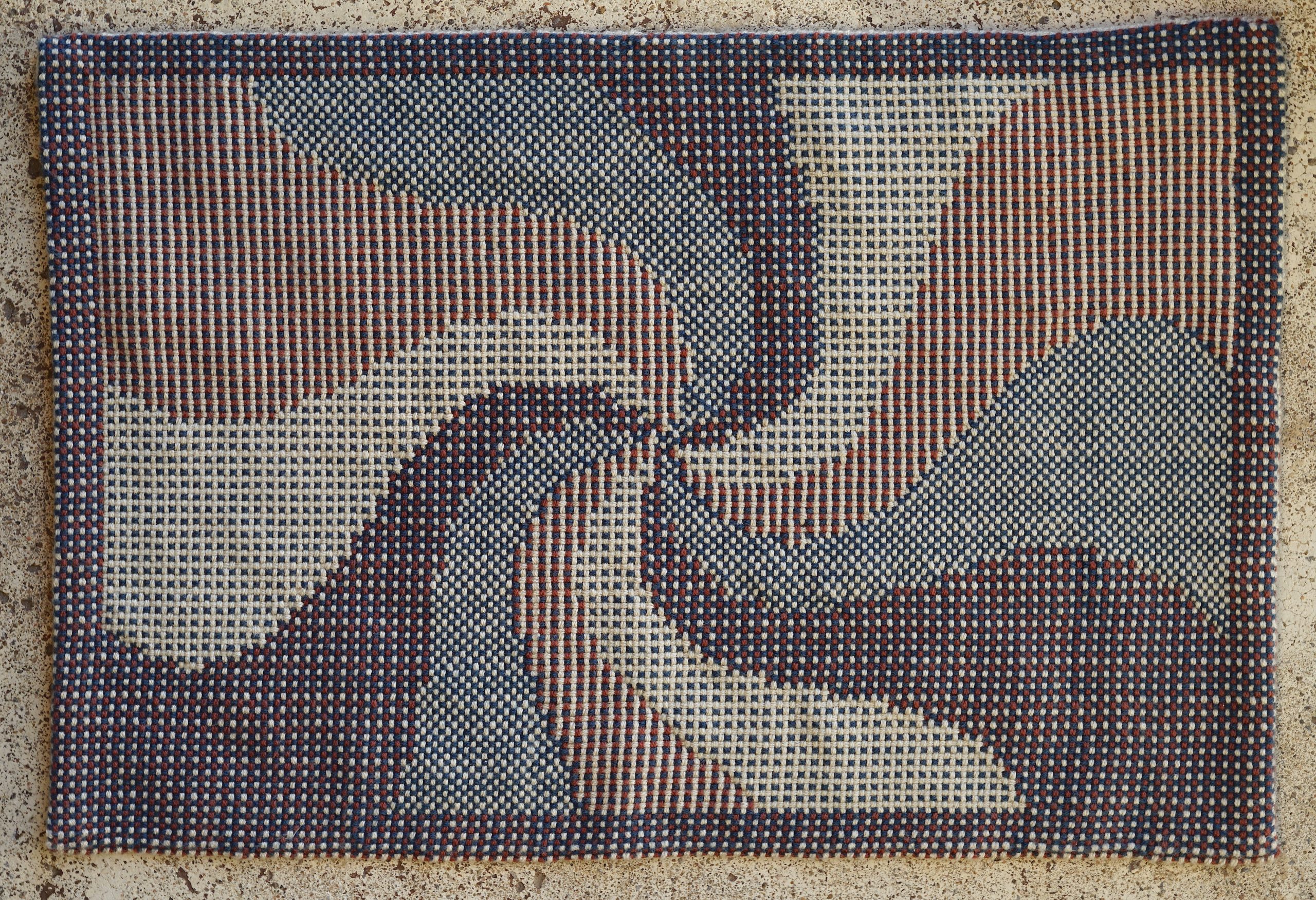
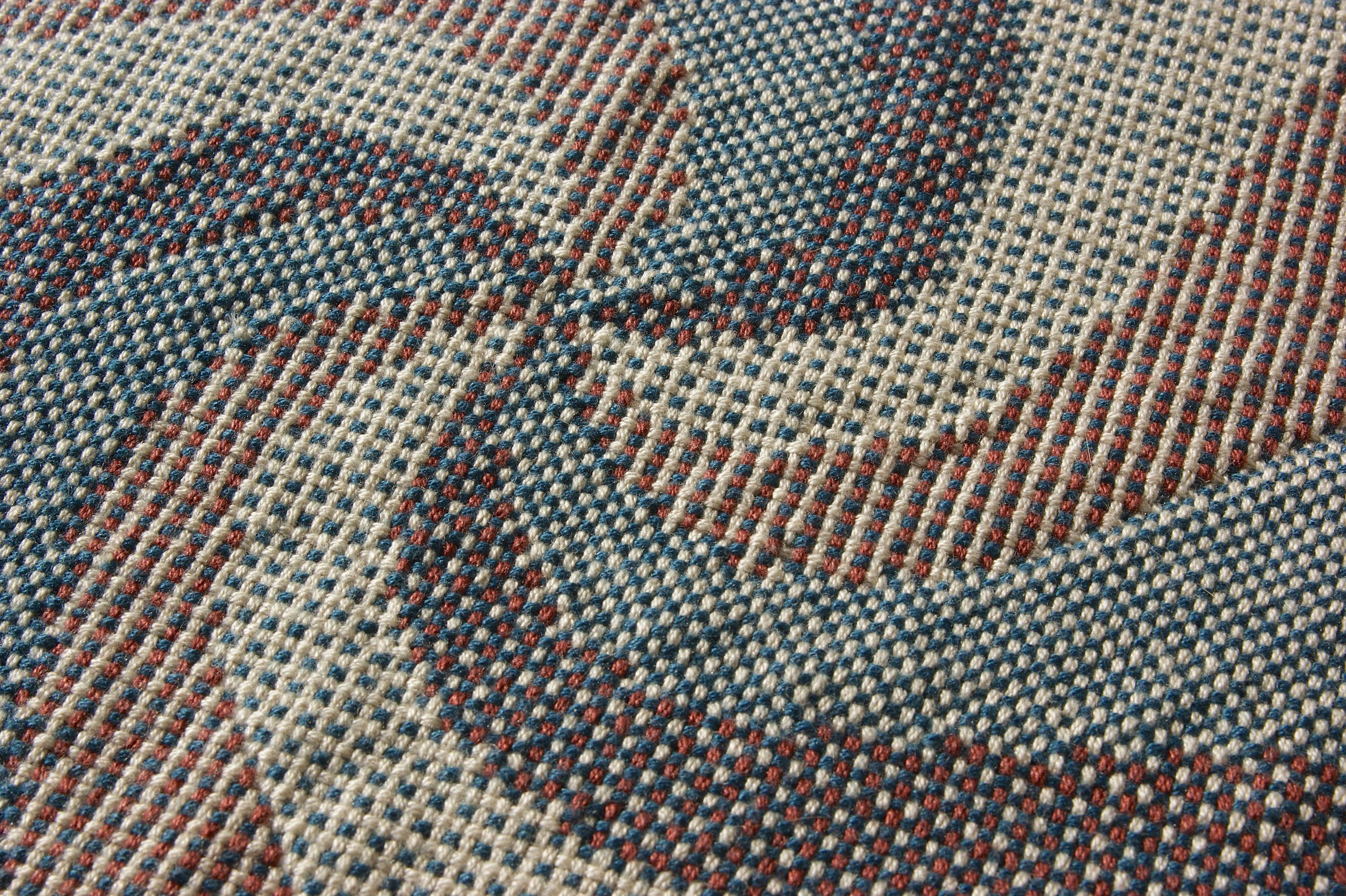
Tourbillon is a double-layer plain weave using a Double Two-Tie (D2T) threading on a 24-shaft electronic dobby loom. I developed a ‘pseudo-Jacquard’ system replacing manual pick-up with a segmented process. Five transitional dobby picks pre-select warp ends for every shuttle passage, with four marker threads as boundary indicators. The stick advances to a marker, the shed changes, and the stick is re-inserted — ensuring accuracy in creating complex, non-repeating sheds.
“This project demonstrates the technical evolution of the Double Two-Tie (D2T) system into a freeform design tool. While the threading remains structural, the liftplan was engineered to allow the two independent plain weave layers to interact according to the organic “”Tourbillon”” motif. Linda Schultz was of great help while developing my understanding of DW on D2T. The visual design was adapted from a Creative Commons image from Pixabay, selected to test the system’s ability to render non-linear shapes that defy traditional block-based constraints.
The core innovation is a dobby-controlled construction system that replaces manual pick-up with a systematic, segmented process. For every shuttle passage, five transitional dobby picks are required to pre-select the warp ends. I utilized four non-weaving marker threads as precise boundary indicators. The process is sequential: the stick is advanced to a marker, the shed is changed via the dobby to the next transitional pick, and the stick is re-inserted to continue to the next marker.
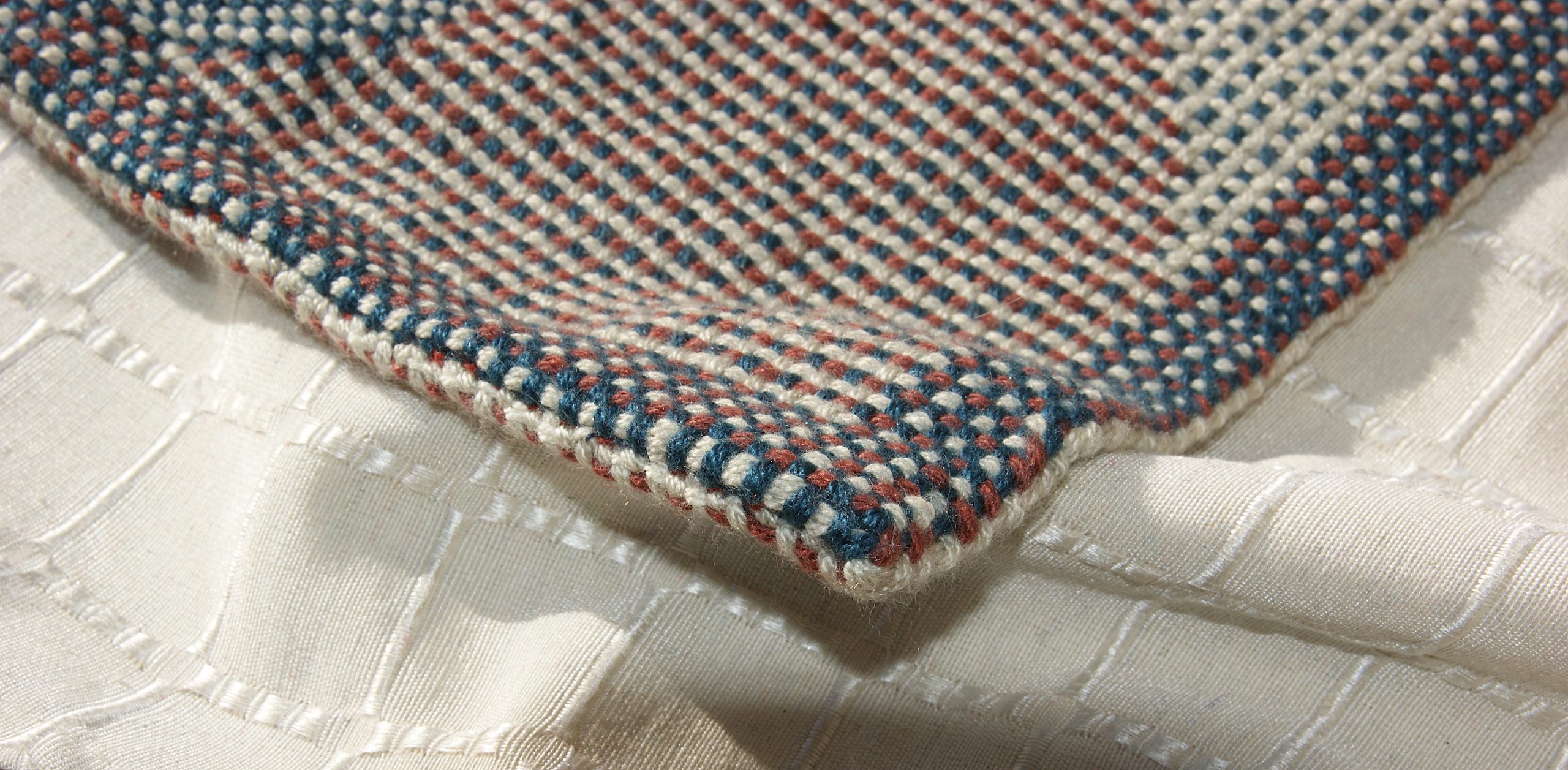
This step-by-step segmentation ensures absolute accuracy in creating complex, non-repeating sheds on my 24-shaft loom. This work serves as a physical validation of the concepts described by Laurie Autio in her 2011 Complex Weavers Journal article, “”Converting a 32-Shaft Loom into a Jacquard.”” Autio noted at the time that her theories had not been physically tested; Tourbillon proves that this level of graphic freedom is achievable through meticulous liftplan engineering and progressive, marker-delimited shed construction. The final result is a true double-layer fabric with a two-layer hem”
Techniques:
“Tourbillon is a double-layer plain weave using a Double Two-Tie (D2T) threading system on a 24-shaft electronic dobby loom. I developed a “”pseudo-Jacquard”” dobby-controlled construction system that replaces manual pick-up with a systematic, segmented process. For every shuttle passage, five transitional dobby picks pre-select the warp ends. I utilized four non-weaving marker threads as precise boundary indicators. The process is sequential: the stick is advanced to a marker, the shed is changed to the next transitional pick, and the stick is re-inserted to continue. This step-by-step segmentation ensures absolute accuracy in creating complex, non-repeating sheds.
Inspired by Nancy M. Searles’ Freeform and Amanda Cutler’s Instruction for weaving drawloom style on a table loom, this work also physically validates the theories described by Laurie Autio in CWJ Oct 2011, which she noted had not been tested at the time. The final result is a true double-layer fabric with a two-layer hem.”
12,75 x 18,75
Materials:
Orlec 4 ply from Maurice Brassard (which is made from 4 threads of 8/2)
Loom:
24-shaft Weavebird from Leclerc – electronic dobby
Jocelyn Blouin

Jocelyn Blouin is a French-Canadian weaver and researcher based in Quebec. His practice is centered on a 24-shaft Leclerc Weavebird, where he explores the structural logic of complex textiles. He is fascinated by what seems “impossible” to weave; for him, the apparent limits of a system are not boundaries, but springboards for further questioning.
My analytical approach is deeply rooted in the frameworks of Marguerite Gingras, Linda Schulz, and Paul O’Connor. While their theories provided my foundation, I am constantly asking “what if?” to see how much further these systems can be pushed through digital loom logic. I am particularly interested in bridging complex textile theory with a practical, fluid execution. By developing methodologies like “pseudo-Jacquard,” I aim to achieve a level of graphic freedom and organic movement that challenges the traditional constraints of multi-shaft weaving.
